From May 25 to 27, 2016, 18 MPA postgraduates of Shanghai University of Finance and Economics, led by associate professor and director of the MPA center Zeng Jimao, went to Osaka to study Japanese urban management and fiscal policies. This academic visit received strong support from Professor Akai Nobuo who worked with the International Public Policies Department of Osaka University.
At the Osaka University, the group of MPA students attended Professor Akai Nobuo’s lecture of “Current Financial Problems in Japan and Relevant Solutions” and a lecture by Law Department’s Professor Kitamura Wataru named “Introduction to Contemporary Japanese Politics”. Professor Akai Nobuo delivered a vivid speech over the tough conditions posed by Japan's current fiscal problems and the causes, benefits to and burdens suffered by people of different ages, solutions to Japanese administrative reform, and restrictions on politics. Meanwhile, Professor Kitamura Wataru addressed contemporary Japanese politics mainly through debates on Japanese development experiences from the angle of political economy, and problems in local self-government system in Japan from the structure of development of financial system and policies by local government. He analyzed the applicability of different theories according to experiences attained by Japan on one hand, and stressed the need for reform on local self-government system and financial system on the other hand.
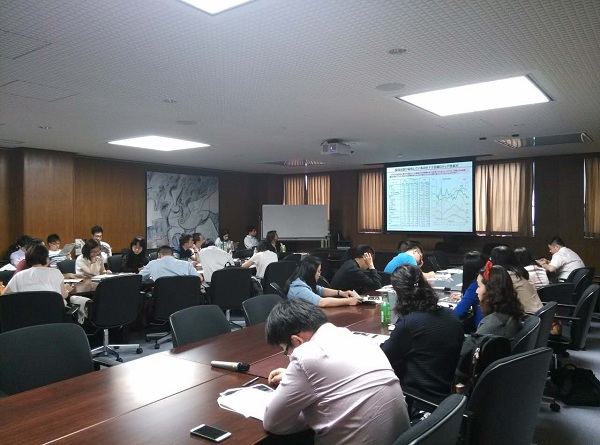
Students Attended Professor Akai Nobuo and Professor Kitamura Wataru’s Lectures
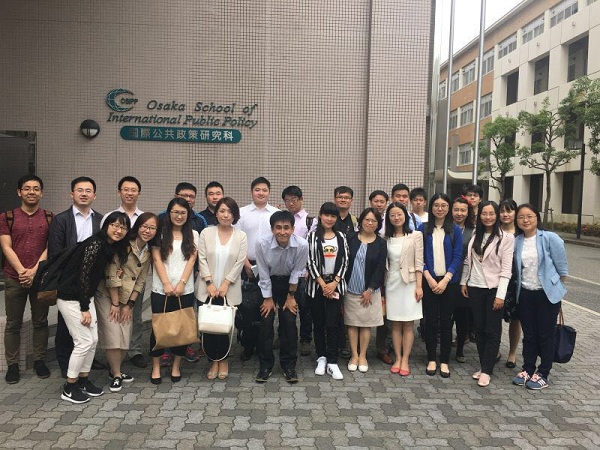
Group Photo Taken Outside the Building of International Public Policies Department, Osaka University
The group also visited Osaka National Tax Agency, Policy Planning Department of Osaka Prefecture, the Parliament and Maishima Incineration Plant.
Mr. Ota Makiko, Assistant Director of Notice and Public Hearing Division of General Affairs Department under National Tax Agency, introduced classification of Japanese taxes and functions of tax authorities. He told the group that in Japan, taxes are divided into national tax and local tax. The National Tax Agency was mainly responsible for implementing equal and effective tax systems. Mr. Ota explained the structure and duties of Japan National Tax Agency, and took the condition in 2013 as an example to introduce,field investigation on individuals and legal persons as well as verification of ignored taxation they carried out, and the highly information-oriented taxation system in Japan in order to implement equitable and fair tax administration. He also elaborated on measures to prevent cross-border tax avoidance in the wake of globalization and the way of Japan’s domestic preparedness for taxation.
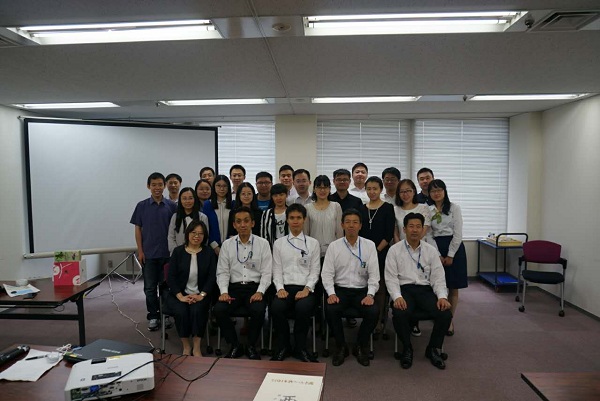
Group Photo with Osaka National Tax Agency Officials after Paying a Visit
On the afternoon of May 27, Osaka Parliament opened. Governor of Osaka Prefecture Matsui Ichiro proposed bills and reported to the Parliament, after which a voting session was held. The group of students, with permit in advance, entered the public gallery after strict security check and observed the Parliamentary proceedings for half an hour. The proceedings were broadcast live on TV, with few Japanese observers present at the Parliament.
After half an hour’s observation, the group went to the Special Conference Room on the third floor of Osaka Prefecture Building, where Yoshida Shinji, director of Planning Division of Policy Planning Department addressed welcoming remarks. Director Yoshida told the group that he paid several visits to Shanghai for fixing up Osaka exhibition hall during the Shanghai World Expo, and received warm welcome from Shanghai government officials. He said the group’s visit to Osaka was also sincerely welcomed. Later, under the chair of Kawahira, director of Planning Section of Planning Division, director Oda Tetsuya illustrated Japan's local self-government system. Director Oda Tetsuya explained limits to jurisdiction of self-government bodies, especially Osaka in details, and talked about challenges facing local self-government system due to economic stagnation. To tackle with the such challenges, Osaka Prefecture united two prefectures and five “kens” including Shiga, Kyoto, Hyogo, Wakayama, Tokushima and Tottori six years ago, calling for a wide union in Kansai, and proposed the idea of establishing Osaka prefecture as vice capital of Japan.
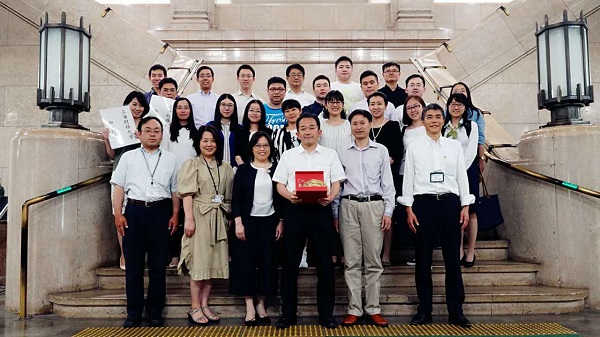
Group Photo with Officials of Planning Division of Policy Planning Department at Osaka Prefecture
Miss Yamagata Atsuko, assistant director of Administrative Reform Section of Osaka Finance Department, introduced “Joint Civil Campaign”, a government-motivated activity where enterprises collaborated with the public and all the three parties worked together to create common values. Special projects included a calling for employment of the elderly in recent years, employment support for disadvantaged groups, and recruitment of the elderly to guard 3500 retail stores. Miss Atsuko said she felt quite proud for having achieved their targets in the above-mentioned campaign with a team of only 7 members.
The group also visited Maishima Incineration Plant, which was located at Maishima, a non-residential landfill island. The Plant, designed by famous Austrian ecological architect Mr. Hundertwasser, had an exterior appearance of yellow and red stripes that symbolized burning fire, as well as curves and green plants that reflected harmony with the nature and lessened the feeling of coldness brought by concrete building. The number of incineration plants at Osaka reached 10 their peak time, and at that time two million tons of wastes were treated a year. After years of “3R Campaign” (Reduce, Reuse and Recycle), waste incinerated at the plant dropped to one million tons a year and incineration plants reduced to seven.
The group not only learned Japan’s advanced experience in urban management, but also discovered quite a lot of differences from China in daily life. For example, they found it extremely convenient to go through the customs formalities at the airport. During their walk from the place where they landed to the baggage transfer station, the airport staff had already picked up their baggage and placed them on the floor in order. In fact, when they arrived at the airport, they saw staff arduously and carefully carrying checked baggage from the plane, which was completely different from the Chinese airport staff’s rough handling of customers’ baggage. Finding garbage bins on the street were classified into six categories and knowing trash sorting in Japan should be cautious, many students, not sure of how paper towels and empty plastic bottle should be categorized, didn’t drop their trash until they reached the hotel. Although Osaka’s population was far less than that of Shanghai, and the city was even smaller than Baoshan District, its downtown area had busier nights, smoother flow of traffic and cleaner and more tasteful restaurants. All the students of the group speak highly of this academic visit, and are willing to recommend other students to attend such activities.